Geography Is the Boss You Can't Outskill: Surviving High-Ping Life in Competitive FPS
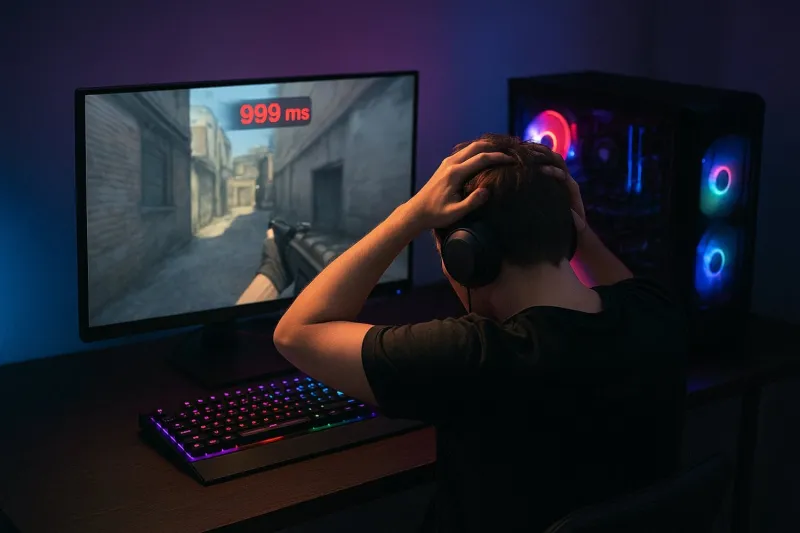
Photo: frustrated gamer looking at high ping latency on monitor, via static.tweaktown.com
The Uncomfortable Truth Nobody Wants to Post
Every FPS community has that one guy who blames his ping for everything. Missed the shot? Ping. Lost the duel? Ping. Whiffed a point-blank spray? Definitely ping. It's become such a meme that most players immediately tune out anyone who brings up latency as a legitimate excuse.
But here's the thing — sometimes it actually is the ping.
Not always. Not even usually. But for a specific subset of competitive players, particularly those living far from major server hubs, in rural areas with limited ISP options, or in regions where the nearest game server might as well be on the moon, latency is a genuine structural disadvantage. Not a cope. A ceiling.
Knowing the difference matters. Because if you're in that group, you could grind aim trainers until your wrist falls off and still never fully close the gap. So let's get real about what's actually going on.
What 'High Ping' Actually Does to Your Game
Latency isn't just a number. It's a delay between your inputs and the server acknowledging them — and in a game like CS2, Valorant, or any fast-paced competitive shooter, even a 40ms gap between you and your opponent can translate to real, measurable disadvantage.
Here's what's happening mechanically: when you click to shoot someone, your client sends that action to the server. The server processes it, checks the game state, and sends a response. Meanwhile, your opponent — who might be sitting 15ms from that same server — already had their action registered before yours even arrived.
This is why peeker's advantage exists, and why it's dramatically worse at higher pings. You're not just seeing a slightly delayed world; you're interacting with it on a slight delay while your opponents are not. In a game decided by milliseconds, that's not nothing.
For players sitting at 80ms, 100ms, or higher consistently, this compounds across every single duel, every single round.
How to Know If You've Hit Your Actual Ceiling
Before you accept any limitations, you need to rule out everything fixable. Run through this checklist honestly:
Wired connection? Wireless introduces jitter — inconsistent latency spikes — that's actually worse than stable high ping in many ways. If you're on Wi-Fi, that's step one.
Router quality? Consumer-grade routers can introduce buffer bloat, which artificially inflates your effective ping under load. Tools like the Waveform Bufferbloat Test are free and will tell you immediately if this is a problem.
ISP plan vs. actual speeds? Run a ping test to your game's nearest server during peak hours (evenings, weekends). If your ping spikes dramatically during those windows, you're dealing with congestion on your ISP's network — sometimes fixable, sometimes not.
Background traffic? Streaming, downloads, and other devices on your network all compete for bandwidth. Prioritize gaming traffic through your router's QoS settings if it has them.
If you've addressed all of the above and you're still sitting at 90ms+ to every available server, congratulations — you've found your actual ceiling. Now what?
The VPN Question: Legitimate Tool or Wishful Thinking?
VPNs get recommended constantly in high-ping communities, and the truth is nuanced. A VPN can help in specific scenarios — primarily when your ISP is routing your traffic inefficiently or through congested paths to the game server. A VPN can sometimes take a cleaner, more direct route and shave meaningful milliseconds off your connection.
Services like Exitlag, Mudfish, and WTFast are built specifically for gaming and actually worth testing. They're not magic, but they're also not snake oil. The key is testing them during your actual play sessions and measuring the results with real tools, not vibes.
That said — if your high ping is purely geographic (you're just physically far from every server), a VPN won't help. It can't bend the speed of light. Packets still have to travel the physical distance, and no software fixes that.
Server Selection: The Move Most Players Skip
This one's underutilized. In games that give you any control over server region selection, experiment deliberately. Sometimes a server that looks farther on a map actually routes better through your specific ISP's infrastructure. Ping to the East Coast might be lower than ping to a Midwest server depending on where your ISP's backbone connects.
In CS2, you can manually configure which data centers you connect to. In Valorant, you can see ping to each region before queuing. Use this information. Don't just pick the server that looks closest on a map — test each one and go with the numbers.
Also worth noting: server population matters for matchmaking quality. A low-ping server with barely any players means longer queues and potentially worse skill-based matchmaking. You may need to balance ping versus queue time depending on when you play.
Playing Smart When You Can't Play Fast
Here's where the mindset shift happens. If you've accepted that your ping has a real ceiling, the question becomes: how do you compete within those constraints?
High-ping players who still climb do it by reducing their reliance on raw reaction time duels. You're not going to out-peek a low-ping player consistently — so don't try. Instead:
Play angles that favor holding. Let opponents come to you. A player holding a tight angle with 90ms ping is in a much better position than one trying to win an aggressive peek at 90ms.
Over-invest in game sense. Knowing where enemies are before you see them means you're pre-aiming, pre-positioned, and not relying on pure reaction speed. This is a skill that completely bypasses the latency disadvantage.
Avoid spray-heavy engagements. Spray control is significantly harder at high ping because your visual feedback on bullet impacts is delayed. Tap shooting and burst fire are more consistent when you're dealing with latency.
Utility becomes your best weapon. Grenades, smokes, flashes — none of these are affected by your ping the way gunfights are. A player who dominates utility usage can control rounds without needing to win every individual duel.
When Acceptance Is the Right Call
Some players are going to read this and realize they've been grinding Radiant or Global Elite while legitimately fighting a battle they can't fully win on the technical side. That's a rough realization, but it's also freeing.
You can still climb. You can still improve. But your ceiling in a pure mechanical duel-heavy environment might genuinely be lower than someone with identical skills and 20ms ping. That's not a character flaw — it's physics.
The players who handle this best are the ones who find the aspects of competitive play that don't care about your ping: the strategy, the communication, the positioning, the mental game. Those skills travel anywhere. And honestly? Building your game around those elements makes you a more complete player even if your ping magically improved tomorrow.
The Bottom Line
High ping is real, the geographic ceiling is real, and dismissing every latency complaint as cope does a disservice to players dealing with legitimate infrastructure disadvantages. But wallowing in it doesn't help either.
Do the work to eliminate every fixable variable. Test VPN solutions properly. Optimize your server selection. Then build your playstyle around what you can control. The arena doesn't care where you're logging in from — but the players who figure out how to compete anyway are the ones worth watching.