Your Lag Isn't the Problem — Your Positioning Is
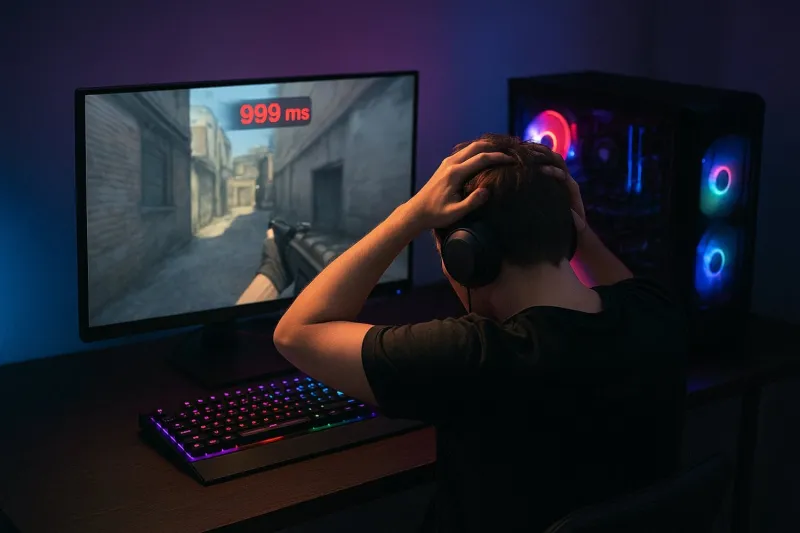
We've all been there. You peek a corner, you get beamed, and before the killcam even finishes playing you're already typing "lag" in team chat. It feels justified. Your ping was sitting at 110ms, the server tick rate was probably off, and clearly the game just decided you weren't winning that duel today.
Except here's the thing — there are players out there running 90, 120, even 150ms pings who consistently rank higher than people with 20ms fiber connections. They're not hacking. They're not just mechanically gifted enough to overcome the disadvantage. They've figured out something that most players refuse to accept: lag punishes bad positioning far more than it punishes good positioning.
So before you call your ISP or start shopping for a gaming VPN, let's talk about what's actually going wrong.
What Lag Actually Does to a Gunfight
Here's the honest breakdown of how latency works in a competitive FPS. When you peek an angle and engage an enemy, there's a small delay between what's happening on the server and what you're seeing on your screen. At 20ms, that gap is almost invisible. At 100ms, it's roughly a tenth of a second — which sounds tiny until you realize that most gunfights at close-to-medium range are decided in under 300ms total.
That delay means you're reacting to a slightly outdated version of reality. The enemy you see just stepped into that doorway — but on the server, they may have already moved a step further. This is why peeking aggressively on high ping feels like gambling. You're committing to a fight based on information that's already a little stale.
The players who understand this stop trying to win the information battle and start controlling it instead.
Playing Ahead of the Server, Not Behind It
The smartest high-ping players in games like CS2 and Valorant don't peek corners — they hold them. This isn't just a playstyle preference; it's a deliberate adaptation to their latency reality.
When you're holding an angle, you're receiving information about an enemy who is moving toward you. Your delay works differently here. You see them step out, and even with lag, your crosshair placement and pre-aim do most of the work. The enemy walking into your sight line doesn't benefit from your ping the way an aggressive peek does.
Contrast that with the player who's constantly wide-swinging and dry-peeking on 100ms. Every single one of those duels is a coin flip where the coin is already slightly weighted against them. They're fighting the server and the opponent simultaneously.
Top-ranked high-ping players in North American ranked queues — particularly those coming from regions like the South or Midwest where server distances can add real latency — consistently gravitate toward anchor roles, passive setups, and crossfire positioning. It's not because they're less aggressive. It's because they've reverse-engineered the game around their actual conditions.
Map Knowledge as a Latency Compensator
Here's where positioning gets really interesting. Map knowledge doesn't just tell you where enemies might be — it tells you when they'll be there. And that predictive layer is worth more than 30ms of ping reduction.
Consider this scenario in Valorant. You know from experience that after a B site execute, enemies rotating from mid will hit a specific chokepoint in roughly four seconds. A player with deep map knowledge is already pre-aiming that angle before the enemy appears. A player without that knowledge is reacting.
For a high-ping player, the difference between pre-aiming and reacting is the difference between winning and losing the round. Pre-aiming eliminates the latency problem almost entirely. You're not responding to visual information with a delay — you're already there, crosshair placed, waiting. The enemy walks into your bullet, not the other way around.
This is why experienced players with middling connections often outperform mechanically gifted players with great ping. Mechanics get you the shot. Map knowledge gets you the angle. And the angle matters more.
The Positioning Habits That High-Ping Players Get Wrong
Let's be specific about the mistakes. These are the positioning choices that hurt high-ping players most:
Aggressive peeking on open, symmetrical angles. Mid-lane duels in CS2, long-range open fights in Warzone — anywhere the fight is roughly equal in information and timing, your lag becomes a real handicap. Avoid these unless you have a massive mechanical edge.
Holding the same spot twice. Your delay means enemies can learn your timing and abuse it. The best high-ping players are constantly micro-adjusting their position, making it harder to time a peek against them.
Playing too close to corners. This one surprises people. If you're holding a corner at extremely close range on high ping, the enemy's model may already be past the corner by the time you see them. Holding slightly further back gives you more time to process the information you're receiving.
Ignoring sound cues for visual ones. Audio has basically zero latency. Footsteps, ability sounds, reload clanks — all of that reaches you faster than the visual update. High-ping players who prioritize audio positioning are essentially bypassing their biggest disadvantage.
What the "Lag Excuse" Is Really Costing You
When you attribute a loss to ping, you close the feedback loop. You stop asking what you could have done differently. You miss the positioning mistake that actually got you killed — the fact that you were standing in a predictable spot, or that you took an aggressive peek you had no business taking, or that you were holding an angle that gave your enemy every advantage.
The players who climb despite high ping do so because they treat every death as a positioning problem first and a latency problem second. That mental shift is worth more than any network optimization you'll find on YouTube.
Your connection might genuinely be rough. Nobody's saying it isn't a factor. But the ceiling for what you can achieve through smarter positioning is almost always higher than the ceiling you've already hit by blaming your ISP.
The Takeaway
Good positioning doesn't just make you harder to kill — it makes your ping irrelevant in more situations than you'd think. Hold angles instead of peeking them. Leverage map knowledge to pre-aim instead of react. Stay off predictable spots. Use audio aggressively. And the next time you die, watch the killcam with one question in mind: was I in the right place, or was I just hoping my connection would carry me?
Spoiler — it probably wasn't the ping.